These have been, are, and will continue to be very intense days, and finding the time to sit down and write for the blog is sometimes difficult, but here I am to give you a few updates on how the research work is going.
First of all, it is only fair to tell you exactly where I am, namely at the UMA (Wildlife Conservation Management Unit) “Biosistemas Productivos Cocodrilo”, which is located just outside Chiná (a town of just over 6,000 inhabitants, less than 10 km from Campeche airport). It is a UMA open to the public by reservation, with the possibility of visiting the site with a guide (I’ll leave the link to their Facebook page here: https://www.facebook.com/BiosistemasProductivosCocodrilo). At the moment, I go there five days a week, cycling about 30 km every day, round trip—do the math yourselves to see how many kilometres I rack up by the end of the month.
So, what exactly do I do when I arrive at the UMA? Now, I am focusing on running pilot experiments, which will later form the basis for experiments on larger sample sizes. What do I mean by that? Basically, a project starts from an idea and from drafting what one would like to do. A literature review is carried out, trying to understand what has already been done and what has not, and whether there are previous studies that can help us write a solid methodology to apply to our data collection. All of this happens behind a desk.
Once the methodology has been written, it is necessary to understand whether it actually works in practice. Ideally, this means running a pilot experiment on a small number of individuals and seeing what happens… you can imagine that things do not always go perfectly! Thanks to pilot experiments, we can identify errors, adjust and adapt our methodology so that it is cleaner and ready to be applied to a larger number of animals. This entire phase is fundamental because subsequent tests require the animal to interact with stimuli and structures actively, and without a solid methodological basis, any result would risk being difficult to interpret.
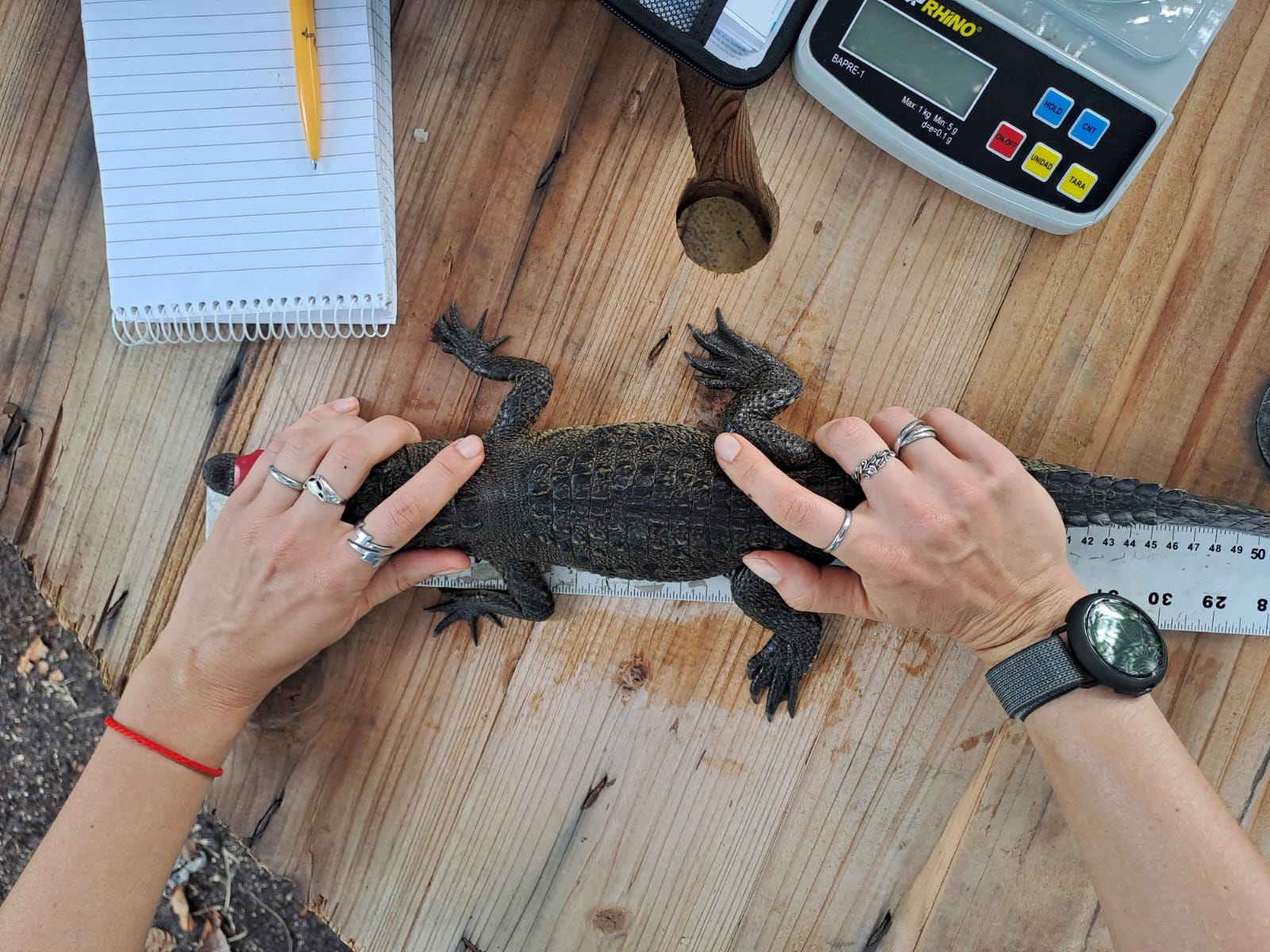
In our specific case, the pilot consisted of isolating a crocodile in a pool containing water and a dry platform, on which we would place a stimulus—namely a 3D-printed object with food attached—so that the animal, attracted by the food, would begin to approach the stimulus and associate its presence with food. The crocodiles chosen for this pilot were selected at random: Gerardo (three months old when we started and now approaching four months) and Stanley (61 cm when we began working).
When testing this first phase, we immediately encountered some problems. The most important one was that the crocodiles were familiar with the people working at the UMA, but not with me. As a result, when I handled them and moved them to a new area, stress-related behaviours were observed—especially because Gerardo had been moved to a pool that was completely unfamiliar to him, while Stanley had been placed in an area where, unfortunately, there were too many people watching him, causing excessive disturbance.
The following day, therefore, we decided to isolate Gerardo in a pool that was exactly identical to the one where he usually stayed with his siblings, while for Stanley, we reduced contact exclusively to one other familiar UMA staff member and to me.
In addition, we introduced a pre-familiarisation phase in which no stimulus was presented; only food was placed on the platform. In this way, the two crocodiles, each in their own pool, would become accustomed solely to me in the context of feeding, which, translated, means that only I would be feeding the animals.
During this pre-familiarisation phase, these small adjustments proved to be essential, as Gerardo immediately changed his behaviour: he appeared much less stressed and, within just a few days, repeatedly climbed onto the platform to feed. With Stanley, on the other hand, we are experiencing a bit more difficulty. This familiarisation phase, which lasted about two hours per day, continued until the animals appeared to have become somewhat accustomed to me. The next phase involved placing a stimulus on the feeding platform, namely the 3D object (randomly, a white cross for Gerardo and a black cone for Stanley), with fish placed nearby.
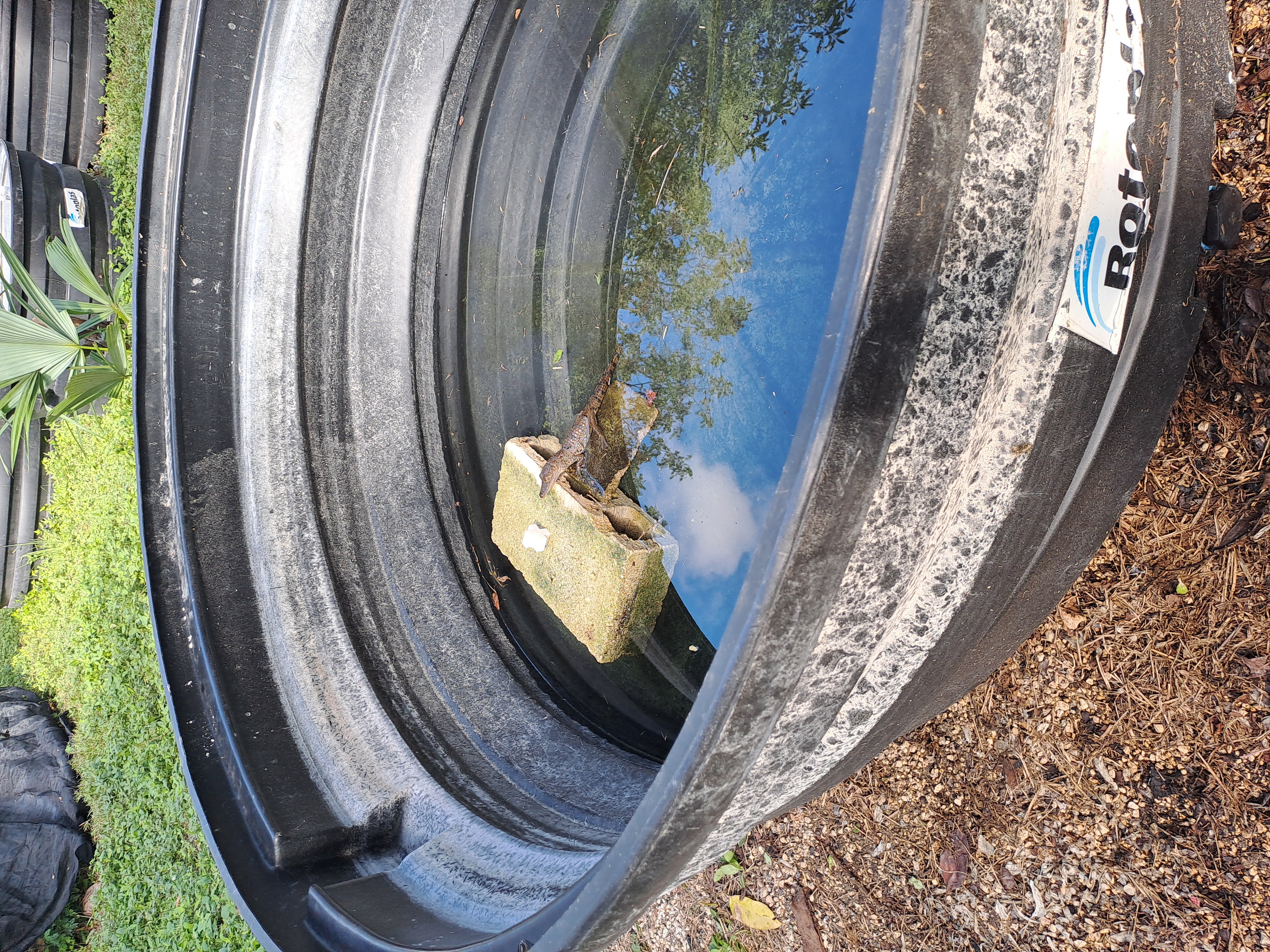
The goal of this phase is familiarisation with a new object. The animals must approach the object and eat, thus learning that it is not something to be afraid of; additionally, it serves to attract the animal toward the stimulus. Gerardo, I must admit, was the quickest to approach the stimulus; with Stanley, however, we need more time.
Right as I am writing this post, we have moved on to the third phase with Gerardo: I placed the stimulus without food and am waiting for him to climb onto the platform… when he does, and only then, I will give him food. In this way, he should learn an additional stimulus–food relationship → if I approach the platform, I get food. This phase is particularly important because it represents the foundation upon which the actual learning tests and comparisons between individuals will be built. With Stanley, we are still quite far behind… could it be that learning is slower with age? With EvOCRO, we aim precisely to understand these differences and provide an answer.
Other things we have noticed during the ongoing pilot experiment are that we must pay close attention to working temperature: crocodiles, being ectothermic animals, are not very active when external and water temperatures are too low (already 23–24 °C is low for them). There must not be too many people around, so curious onlookers unfortunately have to stay away… training work happens between researcher and animal, one-on-one… at most two-to-one!
Taking these and many other aspects into account, we have not only adjusted the pilot experiment, but we have also decided to already form the groups of future animals to which we will teach stimulus–food associations, so that they too can begin to become familiar with me… which means that at the moment I am the one feeding around fifty crocodiles and cleaning their pools of poop!
Meanwhile, as we continue with the pilot experiment, I am buying decorations for the personality tests—yes… decorations! But that is a story I will save for another time…
F. M. C.